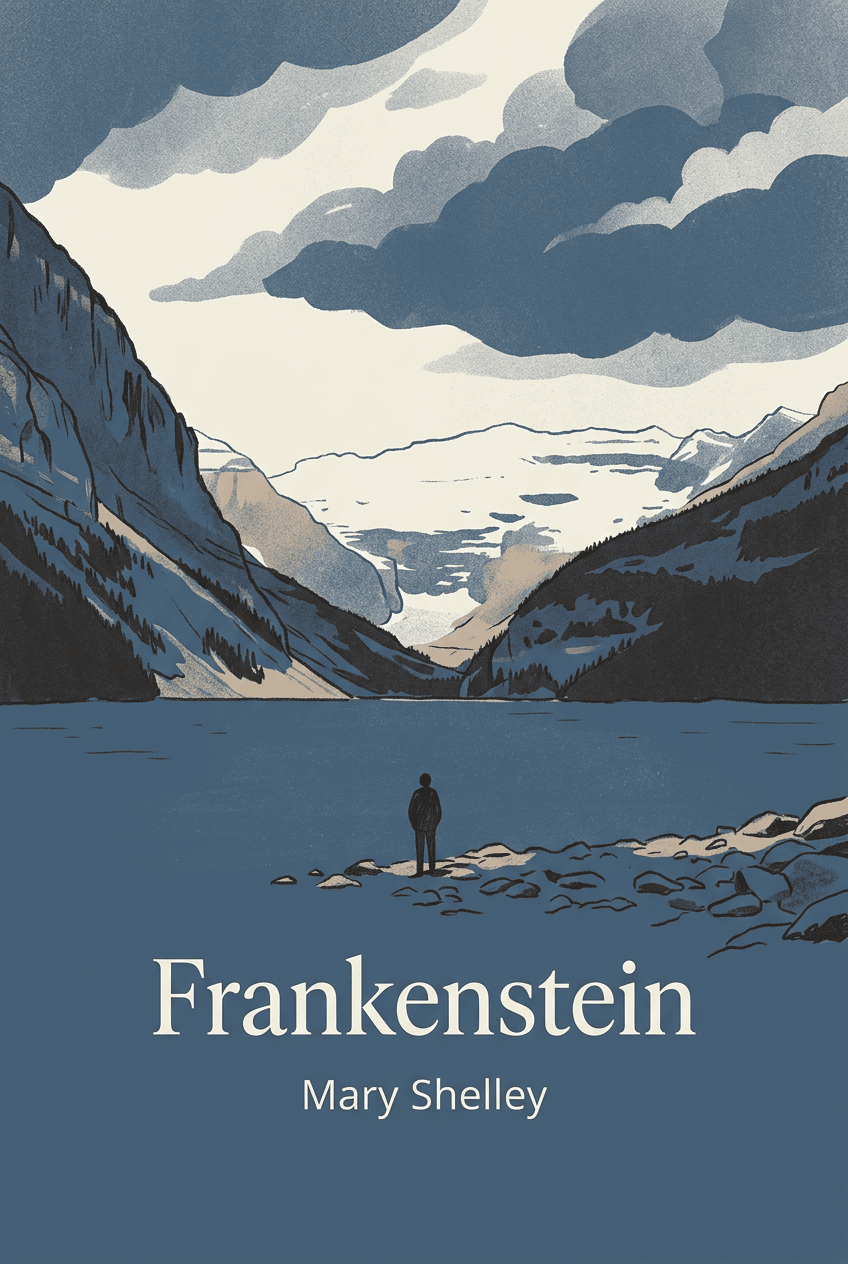
Mary Shelley · 1818 · Gothic novel
Frankenstein
A young scientist gives life to a being he cannot bear to love, and learns too late what a maker owes the thing it makes. The first great myth of modern science, told in nested confessions.
15 guided chapters · ~9 hours of reading
What it’s really about
On its surface, Frankenstein is the story of an ambitious young scientist who discovers how to create life and is horrified by what he makes. Underneath, it is a profound argument about responsibility: what a creator owes its creation, what knowledge costs, and how a being treated as a monster may become one. Mary Shelley tells it through nested narrators, an explorer, the scientist, and the creation itself, so that sympathy keeps shifting and no one is allowed to be simply the villain. It is Gothic, philosophical, and surprisingly tender, a book that feels less dated with every passing decade.
- Creation & abandonment
- Forbidden knowledge & ambition
- Monstrosity & the face
- Loneliness & companionship
- The Promethean spark
From the Foreword
Before page one, a short orientation: the world, the writer, and how to read this particular book. Cross the threshold when you are ready.
- The world you're entering
- The author's moment
- Themes to carry
- How to read this one
Who it’s for
For readers drawn to big moral questions wrapped in Gothic atmosphere, anyone who loves a story that makes you take sides and then quietly switches them. If you enjoy the Romantics, early science fiction, or any tale that asks what we owe the things and people we bring into the world, this one is for you. Patience with formal, early-1800s prose helps; the emotional payoff is worth it.